AI call center solutions are transforming how businesses handle customer conversations. By leveragingAI call center solutions - soluciones de inteligencia artificial para centros de llamadas, companies can reduce wait times, minimize repeated information, and prevent unnecessary transfers, making every interaction faster, more personal, and more helpful. Understanding why AI call center solutions are critical for omnichannel customer journeys highlights the importance of integrating AI across all customer touchpoints, while knowing the key capabilities to look for in contact center AI ensures you select a platform that truly enhances agent performance and customer satisfaction.
From intelligent virtual agents that handle routine calls to real-time coaching tools that support your human agents, AI is reshaping call centers into modern, revenue-driving customer experience hubs.
This guide walks through what AI call center solutions are, how they work, the benefits you can expect, and clear steps to get started or scale what you already have.
Enhancing Efficiency and Strategy with AI
Implementing AI call center solutions allows companies to streamline workflows and handle higher volumes of interactions efficiently. Using advanced computing systems enables rapid processing of complex customer data, reducing wait times and improving agent performance. Similarly, high performance technology ensures that AI platforms can manage multiple communication channels simultaneously, from calls to live chat, without delays or errors.
In addition to operational efficiency, integrating AI insights with marketing strategies helps businesses deliver personalized customer experiences. By leveraging effective online marketing techniques, organizations can connect support interactions with targeted campaigns, improving retention and engagement. Combining support insights with digital marketing strategies allows companies to refine messaging, optimize campaigns, and respond to customer needs more effectively.
Financially, AI call center solutions reduce costs and increase ROI. Companies can rely on strategic financial planning to budget for AI investments, forecast savings, and evaluate long-term benefits. Automating routine inquiries not only reduces overhead but frees human agents to focus on high-value tasks, increasing overall efficiency and enhancing the customer experience.
Top AI Call Center Solutions to Transform Your Customer Experience
Choosing the right AI call center solutions is critical for businesses looking to enhance customer service, improve agent efficiency, and streamline operations. Here’s a list of leading providers in the industry, starting with Bright Pattern.
1. Bright Pattern – Comprehensive AI Contact Center Solutions
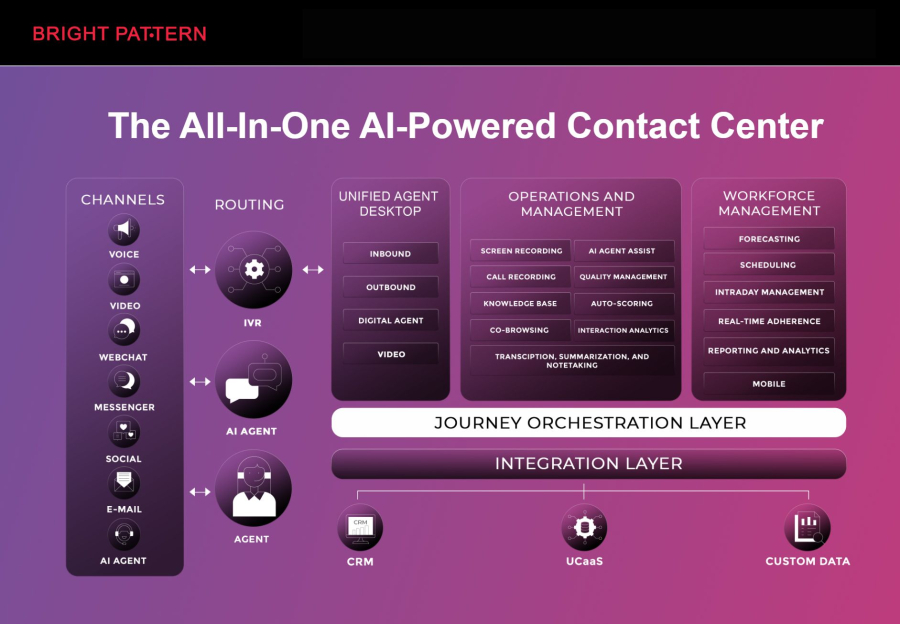
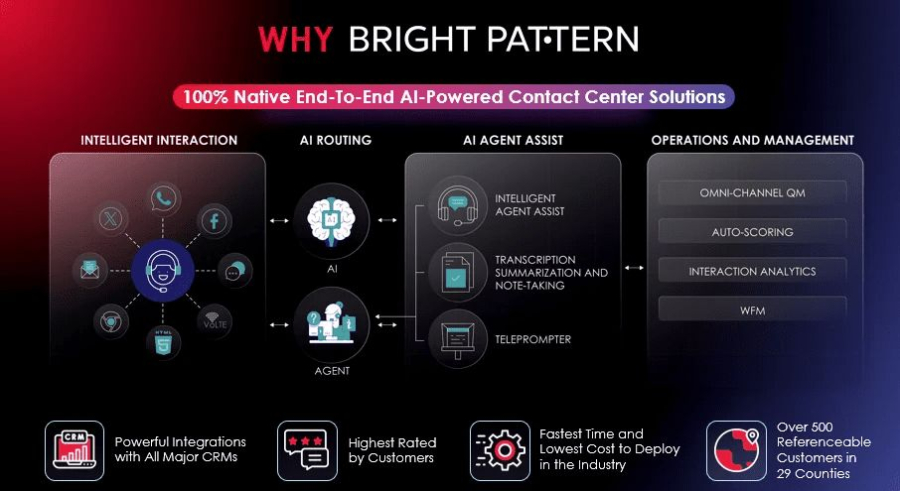
Bright Pattern offers a robust AI-driven platform that modernizes call centers by combining intelligent routing, omnichannel support, and real-time agent assistance. Their solutions are designed to create seamless customer experiences while boosting operational efficiency.
Key features of Bright Pattern AI contact center solutions include:
- Omnichannel support across voice, chat, email, SMS, and social media
- AI-powered virtual agents for routine inquiries
- Real-time agent coaching and performance analytics
- Intelligent call routing to ensure faster resolutions
- Scalable cloud-based architecture for growing businesses
By integrating AI with human agents, Bright Pattern ensures that every interaction feels personal, efficient, and consistent across all channels.
2. Genesys – AI-Powered Customer Engagement
Genesys combines artificial intelligence with omnichannel routing to help businesses deliver personalized experiences. Their predictive analytics and virtual agent capabilities allow call centers to handle complex customer interactions more efficiently.
3. Five9 – Intelligent Cloud Contact Center
Five9 offers cloud-based AI solutions that improve agent productivity and reduce wait times. Features include predictive dialing, automated workflows, and AI-driven reporting tools to optimize operations.
4. NICE inContact – Customer Service Automation
NICE inContact provides an AI-driven platform focused on enhancing customer satisfaction. Their solution integrates with CRM systems, offers intelligent routing, and supports automated self-service options.
5. Talkdesk – AI for Call Center Optimization
Talkdesk leverages AI to streamline call center operations, offering real-time analytics, automated task management, and virtual assistants for handling repetitive inquiries efficiently.
6. RingCentral Contact Center – AI Communication Tools
RingCentral’s contact center solutions use AI to improve call handling, analyze customer interactions, and deliver data-driven insights to enhance the customer experience.
7. Aspect Software – AI and Workforce Management
Aspect combines AI-driven automation with workforce optimization tools to ensure that agents are allocated effectively and customer interactions are handled promptly.
8. 8x8 Contact Center – Cloud-Based AI Solutions
8x8 provides AI-enhanced solutions that unify voice, video, chat, and social media communication, allowing agents to manage multiple channels seamlessly while maintaining high-quality service.
9. Vonage Contact Center – Intelligent AI Routing
Vonage integrates AI for smart routing, real-time analytics, and virtual agent support, helping call centers reduce response times and enhance customer satisfaction.
10. Cisco Contact Center – Enterprise AI Integration
Cisco offers AI-powered contact center solutions that combine omnichannel support, advanced analytics, and virtual assistants to improve both agent efficiency and customer experience.
What Are AI Call Center Solutions?
AI call center solutionsare technologies that use artificial intelligence to automate, assist, or enhance customer interactions over voice and digital channels. They work alongside your existing telephony, CRM, and ticketing systems to improve both the customer and agent experience.
They typically include capabilities such as:
- AI voice bots that answer and resolve common calls
- Chatbots and messaging bots for web, mobile, and social channels
- Real-time guidance and next-best-action suggestions for live agents
- Intelligent routing that connects customers to the right resource faster
- Automated call summaries, notes, and CRM updates
- Analytics that turn every conversation into actionable insight
The result is a call center that can handle more volume, with higher quality, and at a lower cost per interaction.
Key Components of Modern AI Call Center Solutions
Not all AI in call centers is the same. Understanding the core components helps you design the right mix for your business goals.
1. AI Voice Bots and Virtual Agents
AI voice botsare automated agents that talk with customers through natural language instead of rigid menu prompts. Customers can speak in their own words, and the system understands intent, pulls relevant data, and responds conversationally.
Common use cases include:
- Account information and balance inquiries
- Order status, delivery tracking, and simple changes
- Password resets and basic troubleshooting
- Appointment booking, rescheduling, and reminders
- Bill payments and plan upgrades within predefined rules
Well-designed AI voice bots resolve a large share of routine contacts instantly and hand off to human agents when the issue is complex, emotional, or high value.
2. AI Chatbots and Messaging Bots
AI chatbotsextend the same intelligence to digital channels such as web chat, in-app messaging, SMS, and social platforms. They provide an always-on front line for support, sales, and simple service workflows.
Benefits include:
- Immediate responses without queue times
- Consistent answers based on a central knowledge base
- Rich experiences such as quick replies, forms, and step-by-step guidance
- Seamless escalation to live agents with conversation history preserved
3. Agent Assist and Real-Time Guidance
Agent assisttools listen to or read customer interactions in real time and provide agents with helpful prompts. These systems can:
- Surface relevant knowledge articles based on what the customer is saying
- Suggest next best actions, offers, or troubleshooting steps
- Highlight compliance language or disclosures agents need to read
- Auto-generate call notes and summaries for faster wrap-up
This dramatically reduces the time agents spend searching for information and helps new agents ramp up quickly, while keeping experienced agents focused and accurate.
4. Intelligent Routing and Triage
AI-powered routinggoes beyond simple skills-based queues. It can analyze intent, sentiment, customer history, and business rules to connect customers to the right resource on the first attempt.
Examples of smart routing decisions include:
- Prioritizing high-value or at-risk customers for top-tier agents
- Sending billing questions to specialized teams automatically
- Routing urgent or negative-sentiment contacts to escalation queues
- Distributing work fairly across remote and on-site teams
5. Speech Analytics and Conversation Intelligence
Speech analyticsand conversation intelligence tools transcribe calls and analyze them for trends, keywords, sentiment, and outcomes. This turns every conversation into data you can act on.
Organizations use this to:
- Identify common reasons for contact and fix root causes
- Spot product issues or feature requests early
- Measure script and campaign effectiveness
- Improve quality management with objective, consistent scoring
6. Automated Quality Management and Compliance
Traditional quality assurance involves manually sampling a small percentage of calls. AI allows you toanalyze 100 percent of interactionsfor quality and compliance signals.
Capabilities may include:
- Automated scorecards based on defined quality standards
- Detection of specific phrases, disclosures, or prohibited terms
- Alerts for potential regulatory risk or escalations
- Targeted coaching recommendations for each agent
The Business Benefits of AI Call Center Solutions
When implemented thoughtfully, AI delivers value across customer experience, operations, revenue, and employee engagement.
1. Faster, More Frictionless Customer Experiences
Customers want convenience and speed. AI delivers by:
- Reducing wait times through self-service and better routing
- Allowing customers to speak or type in natural language
- Providing answers that are consistent, accurate, and always available
- Maintaining context across channels and handoffs
This leads to higher satisfaction, better net promoter scores, and stronger loyalty.
2. Lower Operating Costs Without Sacrificing Quality
AI helps contact centers manage more interactions with the same or fewer resources, while actually improving service quality.
Cost benefits typically come from:
- Shifting repetitive tasks to AI voice bots and chatbots
- Reducing handle time with smart guidance and auto-summarization
- Decreasing repeat contacts through better first contact resolution
- Optimizing staffing by smoothing peaks and enabling 24/7 support
3. Empowered, More Productive Agents
AI does not replace human agents; itamplifiesthem. When AI takes on repetitive work and research-heavy tasks, agents can focus on higher value conversations that require empathy, negotiation, and complex problem solving.
Agents benefit from:
- Reduced cognitive load thanks to real-time suggestions and information
- Less manual documentation and after-call work
- Targeted, data-driven coaching and development
- Greater sense of impact and career growth
4. Revenue Growth and Better Conversion
AI call center solutions can support revenue as much as they support service. Smart recommendations and timely prompts help agents uncover new opportunities.
For example, AI can:
- Flag cross-sell or upsell options based on customer profile and intent
- Guide agents through effective objection-handling scripts
- Identify high-value leads from inbound calls and chats
- Test and refine talk tracks to maximize conversion rates
5. Richer Insights for Smarter Decisions
Every interaction contains valuable insights about your products, processes, and customer expectations. AI turns call recordings and chat logs into a searchable, structured data asset.
This enables you to:
- See emerging issues and opportunities in near real time
- Align product, marketing, and operations around the voice of the customer
- Measure the true drivers of satisfaction and churn
- Build more accurate forecasts and business cases
Common Use Cases Across Industries
AI call center solutions can be tailored to nearly any industry. Here are some representative examples.
Financial Services and Banking
- Account balances, transaction history, and card activation via voice bots
- Fraud alerts triage and identity checks with guided workflows
- Loan status updates and document checklists through chatbots
- Compliance monitoring across all calls for required disclosures
Retail and E-commerce
- Order tracking, returns, and exchanges through conversational self-service
- Product recommendations based on browsing and purchase history
- Proactive outreach for delayed shipments or stock issues
- Voice-of-customer insights feeding into merchandising and pricing
Telecommunications and Utilities
- Outage reporting and status via interactive voice response with AI
- Plan changes, add-ons, and billing questions handled by bots
- Guided troubleshooting for connectivity and device issues
- Early churn signals detected through sentiment and language patterns
Healthcare and Insurance
- Appointment scheduling, reminders, and basic triage questions
- Benefits explanations and coverage queries through chatbots
- Claim status updates and document requirements
- Quality monitoring to reinforce clear, compliant communication
How AI Call Center Solutions Fit Into Your Tech Stack
AI does not have to replace your existing infrastructure. The most effective deploymentsaugment what you already use, such as:
- Automatic call distributors and dialers
- Customer relationship management systems
- Ticketing and case management platforms
- Knowledge bases and help centers
- Workforce management and quality monitoring tools
Well-architected AI solutions integrate via standard interfaces, event streams, or data connectors, enabling you to:
- Share context across channels and systems
- Keep a single source of truth for customer data
- Automate updates and follow-up actions reliably
- Report on performance across human and AI touchpoints in one view
Key Features to Look For in AI Call Center Solutions
When evaluating options, focus on capabilities that will drive real outcomes for your organization.
1. High-Quality Natural Language Understanding
Your AI should handle real-world language, not just scripted phrases. Look for:
- Support for multiple languages and dialects if needed
- Robust handling of slang, accents, and noisy environments
- Ability to recognize intent and extract key entities such as names or amounts
2. Omnichannel Orchestration
Customers move fluidly between channels. Your AI should too. Seek solutions that can:
- Share context between voice, chat, email, and messaging
- Maintain the conversation state as customers switch devices
- Blend bots and humans in a single, consistent experience
3. Low-Code or No-Code Configuration
To respond quickly to business needs, you want teams outside of engineering to be able to design and adjust workflows. Valuable capabilities include:
- Visual flow builders for conversation design
- Reusable components for common intents and actions
- Testing and preview tools for rapid iteration
4. Strong Analytics and Reporting
Powerful AI should come with equally powerful insight. Look for analytics that allow you to:
- Track containment, deflection, and resolution rates
- View trends in customer sentiment and topics
- Compare performance across teams, regions, and time periods
- Export or connect data into your broader analytics stack
5. Enterprise-Grade Security and Governance
Customer conversations often involve sensitive information. Prioritize solutions that support:
- Data encryption in transit and at rest
- Granular access controls and audit trails
- Configurable data retention policies
- Compliance with relevant industry standards and regulations
A Practical Roadmap for Implementing AI in Your Call Center
Successful AI call center programs typically follow a staged approach. Here is a practical roadmap you can adapt.
Step 1: Clarify Business Outcomes
Start by defining clear goals. Examples include:
- Reduce average handle time by a specific target
- Increase self-service resolution for top contact reasons
- Improve first contact resolution for complex cases
- Raise customer satisfaction or net promoter scores
Align stakeholders around these outcomes, including operations, IT, compliance, and frontline leaders.
Step 2: Map Journeys and Identify High-Impact Use Cases
Analyze call drivers and customer journeys to find places where AI can add immediate value. Focus on:
- High-volume, low-complexity contacts ideal for automation
- Interactions where agents spend time searching systems
- Pain points such as long queues or repeated transfers
- Opportunities for proactive outreach or follow-up
Step 3: Start with a Pilot and Measurable Scope
Pick one or two well-defined use cases, such as order status inquiries or password resets. Launch a pilot with:
- Clearly defined success metrics and baselines
- Close monitoring of customer feedback and containment rates
- A feedback loop for agents and supervisors
Step 4: Iterate, Optimize, and Expand
Use real interaction data to refine intents, flows, and responses. As you gain confidence, expand to:
- More contact reasons and deeper workflows
- Additional channels, such as chat and messaging
- Agent assist and analytics layers for live interactions
Step 5: Embed AI into Daily Operations
To realize full value, AI should become part of how you run the contact center. This includes:
- Regular reviews of performance dashboards
- Ongoing training for agents and supervisors on AI tools
- Cross-functional governance to prioritize new use cases
- Continuous updates to knowledge bases and conversation designs
Essential KPIs for AI Call Center Success
Tracking the right metrics keeps your AI investments aligned with business value. Key indicators include:
Automation and Containment Metrics
- Containment rate: Percentage of interactions fully resolved by AI without human assistance.
- Deflection rate: Volume of contacts shifted from live channels to self-service without loss of satisfaction.
- Task completion rate: How often customers successfully complete their goal with AI.
Efficiency and Productivity Metrics
- Average handle timefor live agents, before and after AI deployment.
- After-call work time, especially where auto-summarization is used.
- Interactions per agentper day without negative impact on quality.
Customer Experience Metrics
- Customer satisfactionscores linked to AI and human-assisted contacts.
- Net promoter scoreand its relationship to faster resolution.
- Customer effort score, especially for journeys that span channels.
Quality and Compliance Metrics
- First contact resolutionfor both automated and assisted interactions.
- Accuracyof information provided by bots and assisted agents.
- Compliance adherencebased on automated monitoring of calls.
Real-World Success Patterns
While every organization is different, successful AI call center programs often share several patterns.
- Human in the loop: AI handles what it does best and seamlessly hands off to people for everything else.
- Customer-first design: Experiences are crafted around customer goals, not internal structures.
- Data-driven iteration: Teams measure, learn, and refine based on live interaction data.
- Strong change management: Agents and supervisors are included early, trained thoroughly, and supported continuously.
Future Trends in AI Call Center Solutions
AI in contact centers is moving fast, and the next wave of innovation is already emerging.
More Conversational, Human-Like Interactions
Advances in language models and speech technology are making AI interactions increasingly natural and context-aware. Customers will be able to explain complex issues in their own words, and AI will guide them through multi-step resolutions smoothly.
Proactive and Predictive Support
Instead of waiting for customers to contact you, AI will help predict needs and trigger proactive outreach. This could include reaching out about potential billing issues, offering help during complex onboarding journeys, or suggesting optimizations before customers experience problems.
Tighter Alignment Between Sales, Service, and Marketing
As call center AI connects more deeply with other business systems, insights from conversations will shape campaigns, product design, and service strategies in near real time. This creates a powerful feedback loop between the contact center and the rest of the organization.
More Personalization With Strong Safeguards
AI will enable highly personalized experiences based on preferences, history, and behavior, while organizations invest in transparent governance to keep data use ethical, secure, and aligned with customer expectations.
Getting Started: Turning AI Into a Competitive Advantage
AI call center solutions have moved from experimental to essential. Organizations that embrace them thoughtfully are seeing faster service, happier customers, more engaged agents, and stronger financial results.
You do not need to transform everything at once. Start with a clear goal, choose high-impact use cases, involve your frontline teams, and build from early wins. With the right strategy and partners, your call center can evolve into a modern customer experience engine where AI and people work together to deliver remarkable outcomes.
The opportunity is clear: every call, chat, and message becomes a chance to serve better, learn faster, and grow stronger. AI is the catalyst that makes that scale possible.
